Chiharu Shiota
In performances and installations, she is preoccupied with remembrance and oblivion. Earth and water recall the lasting and the fleeting. There is a concern with drifting between the cultures of Asia and Europe, as well as with a farewell to childhood.
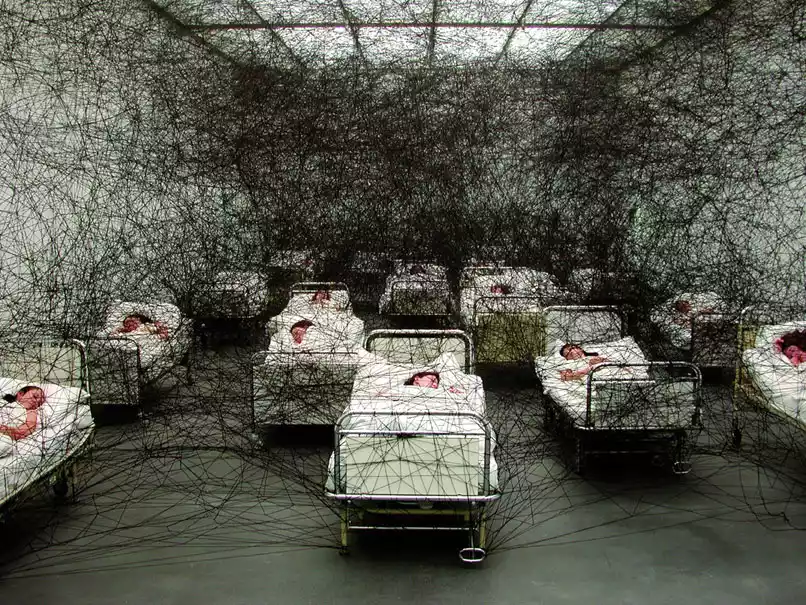
The young Japanese artist Chiharu Shiota deals generously with her dreams. Her installations and performances lead into sleep, night, and the self-forgetfulness of the dreaming body. Far from Japan, her disorientation and fear of losing the personal and individual have become the leitmotifs of her art. From them arise theatrical images inviting viewers’ participation.
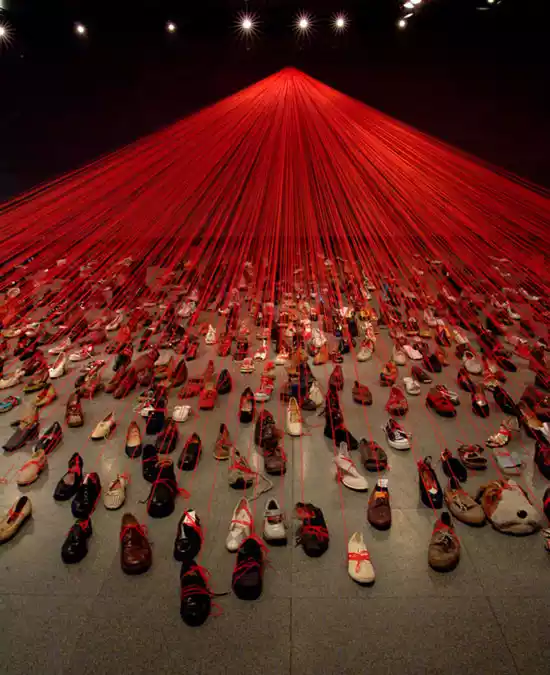
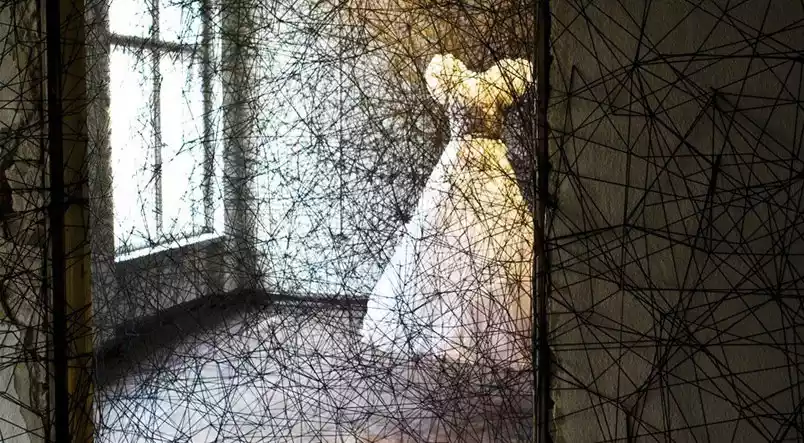
In 1999 she created the installation Dreaming Time: From the framework of a house, whose roof and walls were made partly of crossed chopsticks, a bid to escape was made by an army of shoes, all of which were tied with red threads to the middle of the house and hence kept within a certain radius, yet not a single shoe pointed inwards. The worst of it was that every shoe had lost its partner and had to make its way in the world alone.
From Japan Chiharu Shiota brought a chest of old toys and buried it. She later unearthed the dolls and cuddly animals and tied them with cords to the floor and walls. The work was called Bondage, recalling rites of exorcism to counter loss of protection within the family.
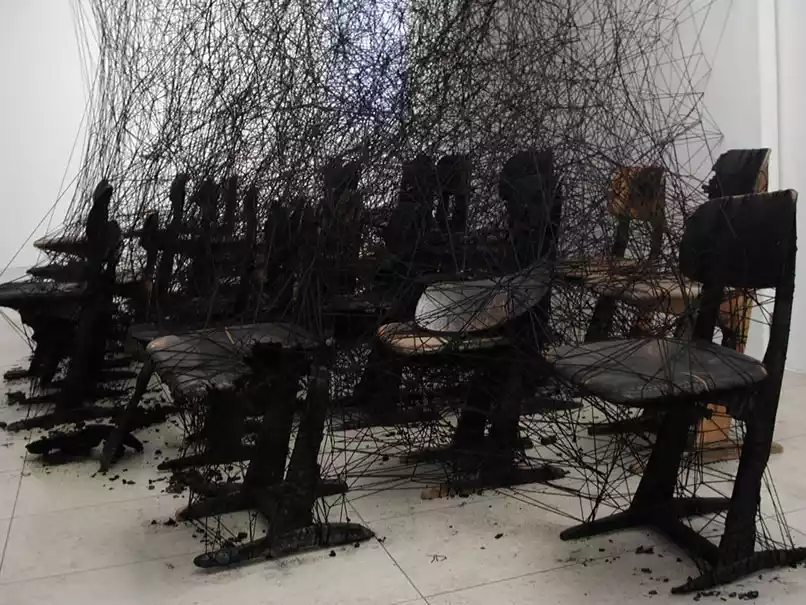
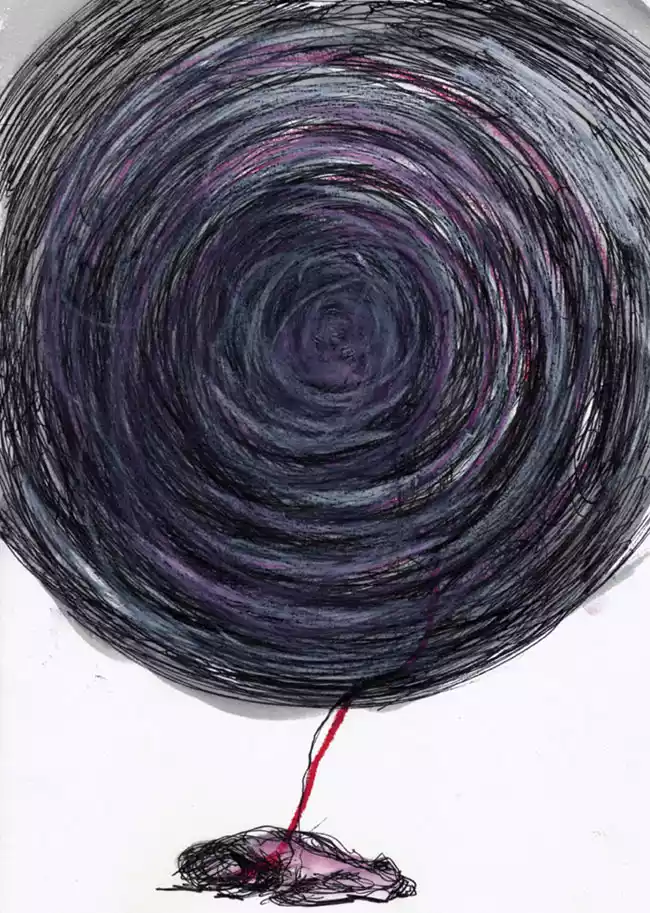
‘Maybe I am unable without fretting to create more art, and if I am unable to create more art, I become more fretful,’ so she once wrote. But just as a story-teller keeps the spooks of the night at a distance, she bans fear from her works. In her installations she has wound herself in black woollen threads like in a cocoon. In her exhibitions she has slept between a bed and the surrounding walls among these threads forming an impenetrable thicket. The spatial complex of black lines was both threatening and comforting and offered protection and stability. But the lines also created labyrinthine structures, calling at every point for new decisions. Anxiety at the end of childhood was just as much woven into them as were metaphors for a technology giving contemporary life its contours. Electronic webs, neural channels, personal relationships: From all sides folk nowadays are called upon to be flexible.
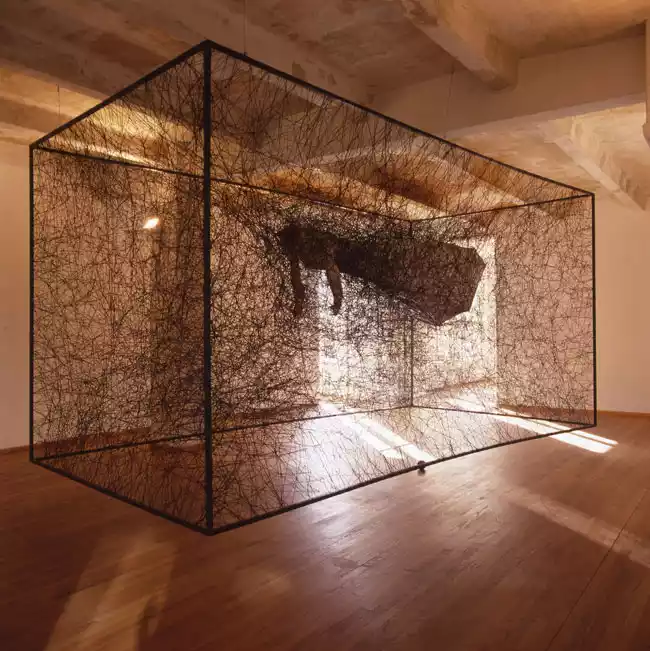
A photo shows the cut threads of an early installation. Nothing more remains when the spooks have been taken down. Chiharu Shiota makes neither drawings nor notes in advance, for fear of losing her inner images. In Berlin, where she has been living since 1999, she has no atelier and works only on location. A strange thrift, which accepts only the fleeting.
Biographical and cultural transformations come into contact in her works. ‘Memories can’t be rinsed away’, she claims. She translates resistance to the flow of time into poetical and memorable images. In the installation Under the Skin eight items of clothing hang above a washing basin and reach nearly to the ceiling. They hold each others’ arms like eight sisters from a fairytale with an adventure to undergo. Soil clings to, and water drips from the items. They have already come a long way, and smears and smudges bear witness to their experiences.
Chiharu Shiota was born in Osaka in 1972 and began her studies in Kyoto. She began with painting, but at present paints only ”in the air’ with her threads. An exchange-semester took her to Canberra in Australia, then she came in 1996 to Germany, where she studied under performance artists Marina Abramovic and Rebecca Horn, who encouraged her in her way of working with perceptions of the body and its experiences in space.
In Germany she gained recognition already as an art-student through taking part in group and solo exhibitions, leading her within two years from the fringe to the centre. Exhibitions in the Ludwig-Forum in Aachen, the House of World Cultures in Berlin and the Queensland Art Museum in New York, as also her taking part in the Triennial of Modern Art in Yokohama, have put her on the best path to international recognition.
‘What’s under my feet, what I eat, whom I meet — all that influences my art’, says Chiharu Shiota, who after four and a half years in Germany is gradually feeling surer of ‘putting out roots and leaves’ in Berlin. But despite the meteoric rise of her career, she has the feeling that her surroundings are changing even faster. The resulting discrepancies provide her with even more material for her evolution.
Chiharu Shiota (b. Osaka, 1972) lives in Berlin.
— culturebase@hkw.de

