About the section
The exhibition lasted two weeks. In the early 1850s Henry Cole, first director of the institution that became the Victoria and Albert Museum, filled a room at Marlborough House with what he considered bad design: wallpapers and fabrics printed with naturalistic leaves and flowers, objects smothered in ornament, materials used against their nature. Labels spelled out each failing. The press called it a Chamber of Horrors. The public was amused, the manufacturers whose goods were on show were mortified and complained, and the Gallery of False Principles closed. Of its 87 objects, only 17 have so far been identified in the V&A’s collections.
It is a comic episode, but it shows how seriously the nineteenth century took design. This section covers objects made for use: furniture, ceramics, textiles, posters, cars, typefaces and clothes. It treats them as works with makers, clients and histories, and asks how they came to be collected next to paintings.
A museum for manufacturers
The V&A grew from the Great Exhibition of 1851 in Hyde Park, which drew an estimated six million visitors to the temporary Crystal Palace. Afterwards a Treasury grant of £5,000 bought a selection of exhibits for a new Museum of Manufactures, opened in 1852 with Cole as director. He wanted it to be “a schoolroom for everyone,” instructing designers, manufacturers and the public in good design. The museum moved to South Kensington in 1857, and its new buildings were decorated by artists and designers including Owen Jones and William Morris. Its refreshment rooms were the first of their kind in any museum.
Art and industry reconciled
Nearly seventy years later, the Bauhaus set out to close the same gap from the other side. Walter Gropius founded it at Weimar in 1919 as a school in which architecture, performing arts, design and the applied arts carried as much weight as fine art. Its teachers included Wassily Kandinsky, Paul Klee, László Moholy-Nagy and Josef Albers, and the school set out to reconnect art with daily use. After the Nazis closed it in 1933, Josef and Anni Albers took its methods to Black Mountain College in North Carolina and later to the Department of Design at Yale.
Fashion enters the museum
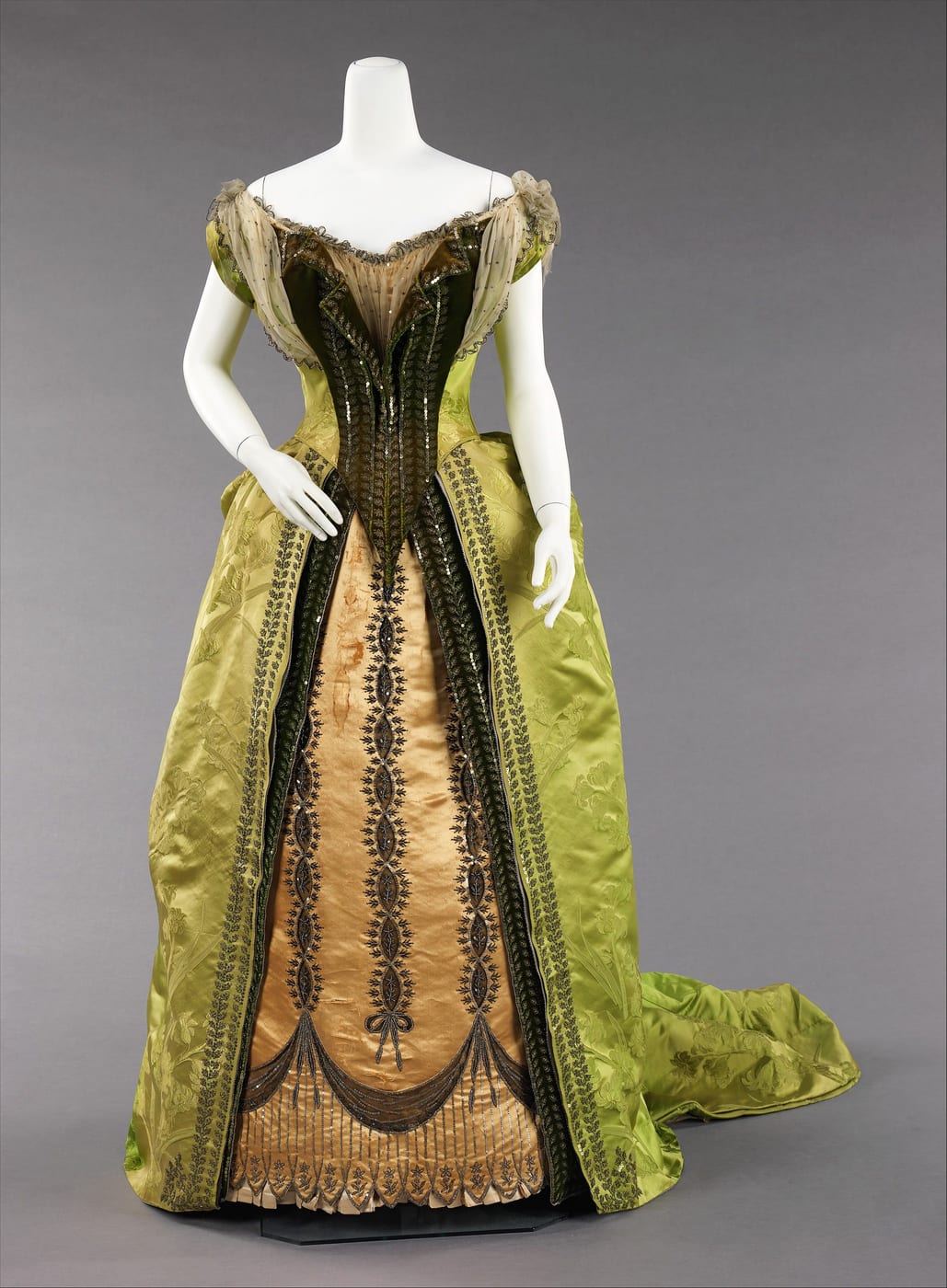
The V&A claims the largest and broadest holding of dress anywhere, covering five hundred years: rare seventeenth century gowns, eighteenth century mantua dresses, evening wear of the 1930s by Coco Chanel and Elsa Schiaparelli, and daywear of the 1960s by Mary Quant and Barbara Hulanicki.
Its most famous single garment may be Christian Dior’s Bar suit. Dior opened his house on 12 February 1947 with a collection he called La Ligne Corolle. Carmel Snow, editor of American Harper’s Bazaar, named it the New Look on the spot. Bar paired a fitted, hip-length jacket of natural tussore silk, padded at the hips, with a long pleated skirt of black wool crêpe mounted on stiffened taffeta and padded with cambric, which makes it exceptionally heavy. Dior’s own notes record that it cost 59,000 francs. The suit came to the V&A as a gift from the house, after the photographer Cecil Beaton approached Dior on the museum’s behalf. The museum’s catalogue is candid that the example may be a 1950s remake rather than a garment of 1947.
What to look for
Turn the object over. Design history lives in seams, joints, labels and fastenings, in the gap between a sketch and a factory, and in the paperwork that tells us who paid for what. The articles below follow designers, manufacturers and collectors, and the museums that decided which everyday things were worth keeping.
Sources
- Building the Museum, Victoria and Albert Museum
- Bar, Christian Dior, 1947, Victoria and Albert Museum
- Fashion, Victoria and Albert Museum
- Bauhaus, Tate