About the section
The plate is pewter, about 16.7 by 20.3 centimetres, coated with bitumen dissolved in oil of lavender. Joseph Nicéphore Niépce set it inside a camera obscura near the window of his upstairs workroom at Saint-Loup-de-Varennes in Burgundy and left it there for several days. What came back was a faint view of a courtyard, outbuildings and trees. Made in 1827, it is the earliest surviving photograph taken with a camera, and it now belongs to the Harry Ransom Center at the University of Texas at Austin, which bought it in 1963 with the Gernsheim Collection. Niépce himself was modest about the result, calling it in December 1827 “the first uncertain step in a completely new direction.”
Photography has always lived a double life, as a technology and as an art, and this section follows both. It covers the inventors and the studio portraitists, the documentary photographers and the modernists, the museums that took the medium seriously and the long period when many did not.
1839 and after
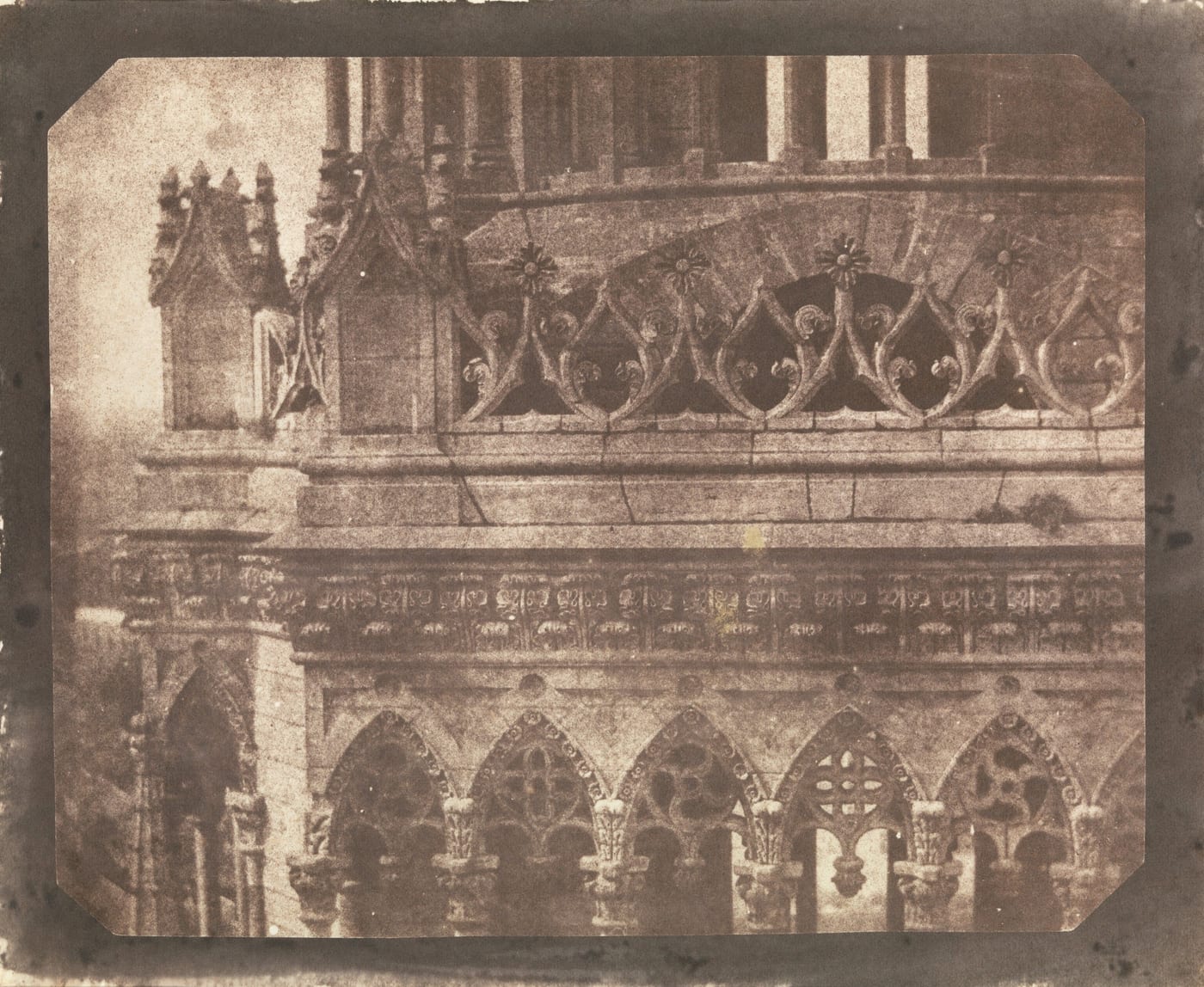
The invention of photography was announced in France and England in the same year, 1839. Niépce had died in 1833, but his partner from 1829, Louis-Jacques-Mandé Daguerre, kept improving the process and introduced the daguerreotype that year. In England, Sir John Herschel coined the word photograph in 1839, from Greek roots meaning drawing with light. The early paper print had its own culture, and Tate Britain surveyed salted paper prints from 1840 to 1860 in its 2015 exhibition Salt and Silver.
Museums arrived early. In 1858 the Photographic Society of London held an exhibition in the refreshment rooms of the new South Kensington Museum, now the V&A, a sign of how closely photography was tied to the Victorian project of education through design and display.
The modern eye
Eadweard Muybridge, born in 1830, around the time the medium was invented, became one of its early pioneers; Tate Britain gathered the full range of his work in 2010. In the 1920s the New Vision developed as a photography movement directly tied to the principles of the Bauhaus. When László Moholy-Nagy left Europe in 1937 to found the New Bauhaus in Chicago, later the Institute of Design, photography became perhaps its most important department, directed by Harry Callahan. It treated the camera as a medium distinct from all others and turned its attention to the American city and its architecture.
Documents and colour
American social realist photographers documented rural poverty during the Great Depression of the 1930s and 1940s. Later, William Eggleston’s pictures of the American South did more than anyone’s to win colour a place in art photography.
Prints, negatives and files
Tate’s definition is a useful reminder that a photograph can be a negative or a positive, a chemical print or an inkjet print from a digital file. Each form raises its own questions about originals and copies, about vintage prints and later editions. The articles below take those questions seriously, alongside the pictures themselves and the people who made them.
Sources
- The Niépce Heliograph, Harry Ransom Center, The University of Texas at Austin
- Photography, Tate
- Bauhaus, Tate
- Building the Museum, Victoria and Albert Museum