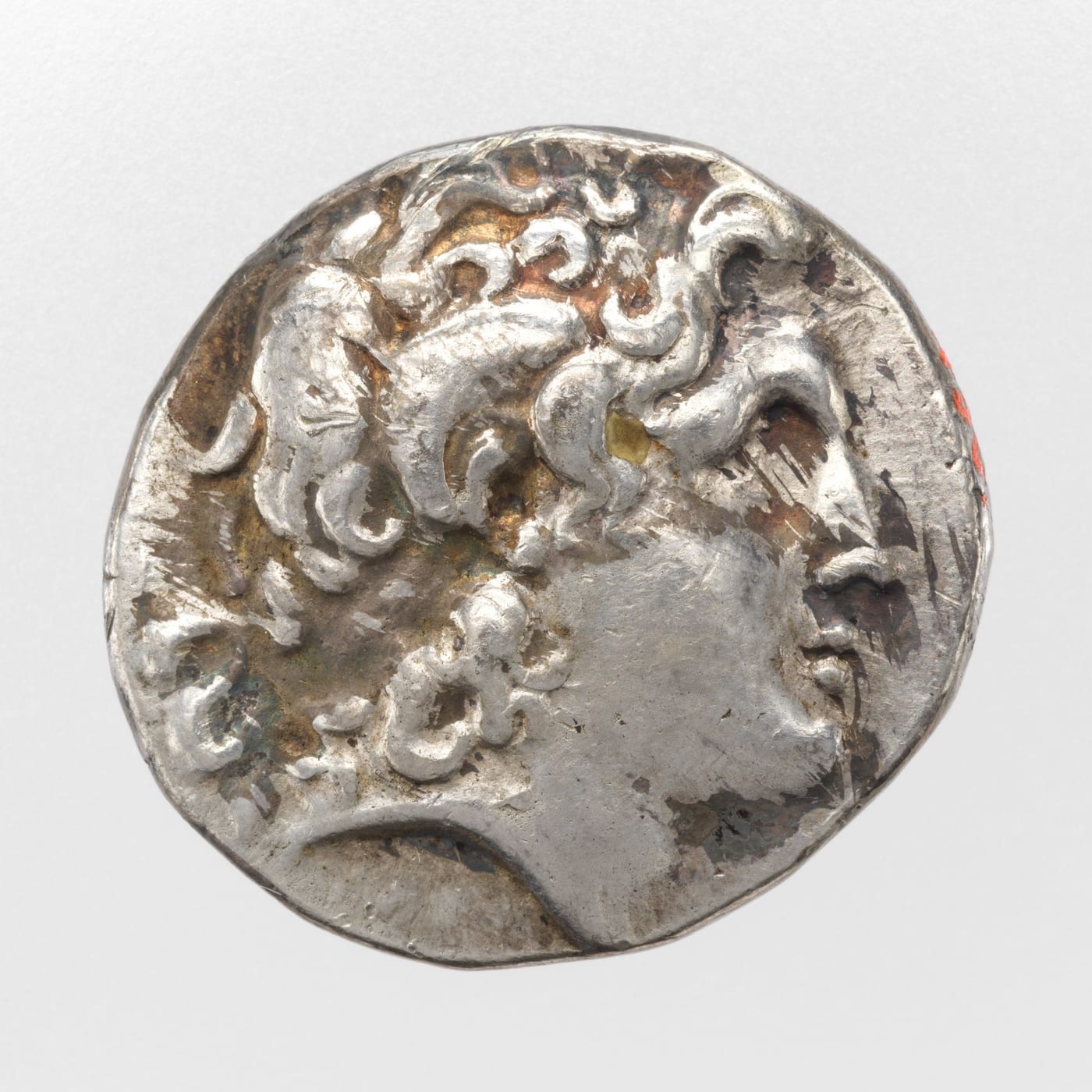
A silver coin less than three centimetres across, struck between 297 and 281 BCE, shows a young man with long hair swept up from his forehead, his eyes turned upward, and a horn curling around his ear. The face belongs to Alexander the Great, who had been dead for more than twenty years when the coin was made. The man who paid for it was Lysimachus, one of Alexander’s companions and bodyguards, who by then called himself king of Thrace.
That coin, now in the Art Institute of Chicago, is a good place to begin a history of the ancient coin portrait, because it shows the portrait already doing political work. It is a likeness, but it is also a claim.
Alexander as a model
Alexander died in 323 BCE. His generals, friends and heirs then spent some forty years fighting over his empire. Lysimachus, who reigned from 323 to 281 BCE, put Alexander’s image on his coinage to present himself as the rightful successor and to support his hold on Thrace.
The Art Institute’s catalogue entry credits Alexander with setting the conventions of royal portraiture, and the coin shows them clearly: a youthful, clean-shaven face, long locks rising above the forehead, an upward gaze. The horns are the horns of Ammon. They signal Alexander’s claim to be the son of the Egyptian god Ammon, a claim said to have been confirmed by the oracle at the sanctuary of Zeus-Ammon at Siwa in Egypt.
Turn the coin over and Lysimachus speaks for himself. The reverse names him as king, and the goddesses Athena and Nike crown his name with laurel, a sign of victory or honour. A lion on the shield beside Athena refers to the story that Lysimachus killed a lion with his bare hands, and it ties him again to Alexander, who used the skin of the Nemean lion as an emblem of power and courage. Obverse and reverse divide the labour. The dead king supplies authority, and the living one supplies his name.
Why a profile
The profile is so familiar on coins that it is easy to forget it was a choice. A second Art Institute record, for a Ptolemaic tetradrachm, sets out the reasoning plainly. The first portrait coins were meant to identify the ruler. The front became a mirror of how the sovereign wished to be seen, and the back carried a message about achievements or intentions. The profile suited the very shallow depth and small surface of a coin.
The images were cut by engravers into bronze dies, one for each face, and the coins were struck one at a time in a process close to modern minting. Because few subjects ever saw their ruler in person, recognisable attributes did much of the identifying: crowns, robes and other regalia. Alexander’s successors copied his crown, a plain headband known as a fillet.
The founder’s face
In Egypt the Ptolemies turned a portrait into a dynastic brand. A gold pentadrachm issued by Ptolemy II, between 285 and 247 BCE, carries not his own face but that of Ptolemy I, the founder of the dynasty. Ptolemy I wears a diadem and the aegis, a magical garment associated with both Zeus and Athena that was believed to protect its wearer and drive off enemies. On the reverse an eagle stands on a thunderbolt, another reference to Zeus, with whom the early Ptolemies linked themselves in the form of Zeus-Ammon. The Art Institute reads the whole design as a statement of the dynasty’s divine origins.
The founder’s portrait outlived him by generations. The Art Institute’s silver tetradrachm portraying Ptolemy I is dated 176 to 175 BCE, in the reign of Ptolemy VI, several reigns after the founder’s own. A coin portrait, in other words, did not always show the ruler of the day. It could show the source of his right to rule.
Two faces, one profile
Cleopatra VII offers the most pointed example of portrait as alliance. A silver tetradrachm issued by Mark Antony between 37 and 33 BCE pairs him with Cleopatra VII, queen of Egypt. She had allied herself first with Julius Caesar and then with Antony in an effort to keep Egypt independent and her own authority intact.
The Art Institute points out two details. Cleopatra’s portrait takes the front of the coin, marking her as the senior partner. And her profile is an exact copy of Antony’s. The two rulers advertised their partnership by sharing a face, with a crown circling her carefully braided hair to mark her status as queen. The alliance did not last. Caesar’s heir Octavian defeated the couple in a sea battle in 31 BCE, and both took their own lives.
Rome learns the habit
Rome came to the coin portrait late. It began producing coinage in the late fourth century BCE, and for centuries its coins showed the heads of gods and goddesses, usually in profile, with animals, symbols and references to events on the reverse. Only in 44 BCE did the portrait of a living person, Julius Caesar, appear on Roman coins. After that, profile portraits of rulers and members of the imperial family became the standard subject across the empire, and they usually stayed in profile until Late Antiquity.
Augustus made the portrait into a long-term instrument. A silver denarius of 19 to 18 BCE shows his head to the left, crowned with oak leaves, with a comet on the reverse. Augustus, who reigned from 27 BCE to 14 CE as the first Roman emperor, required that his portraits keep a youthful appearance for the rest of his life, according to the Art Institute. The coin portrait here stops recording age at all. It holds the emperor at a fixed point, much as Lysimachus had held Alexander.
A beard for two centuries
By the second century CE the imperial coin was a polished product. From the accession of Nerva in 96, Rome was ruled by the five men later known as the Good Emperors, and the Art Institute connects the peace of that period with the sheer number of coins produced and the skill of their images. Gold aurei of this era were often perfectly round, cleanly struck and well centred.
An aureus of Hadrian struck between 120 and 123 shows the change that defined his image. Hadrian wears a short beard, and the fashion he started held among his successors for the next two hundred years. The coin is on view in the Art Institute’s Gallery 152.
Scale is worth keeping in mind with all of these objects. The Hadrian aureus is 1.9 centimetres across. The Augustus denarius is two centimetres. The Lysimachus tetradrachm is 2.7, and the Cleopatra tetradrachm, 2.6 centimetres wide, weighs 15.22 grams. Every portrait discussed here fits on a fingertip, and every likeness had to be read at that size. The Chicago coins also carry the history of American collecting with them: several came to the museum as gifts of William F. Dunham and Martin A. Ryerson, while the Hadrian and the Cleopatra were bought with purchase funds, including the Katherine K. Adler Memorial Fund.
The beard is a small thing, a few strokes cut into a die, but it shows how completely the coin had become a portrait medium. Alexander’s youthful, clean-shaven face had set the rule for kings across the Greek world. Four and a half centuries later, a Roman emperor could change the look of power for generations simply by appearing on his money with a beard.
Sources
- Tetradrachm (Coin) Portraying Alexander the Great, issued by King Lysimachus of Thrace, Art Institute of Chicago
- Pentadrachm (Coin) Portraying King Ptolemy I Soter, Art Institute of Chicago
- Tetradrachm (Coin) Portraying Ptolemy I, Art Institute of Chicago
- Tetradrachm (Coin) Portraying Queen Cleopatra VII, Art Institute of Chicago
- Denarius (Coin) Portraying Emperor Augustus, Art Institute of Chicago
- Aureus (Coin) Portraying Emperor Hadrian, Art Institute of Chicago