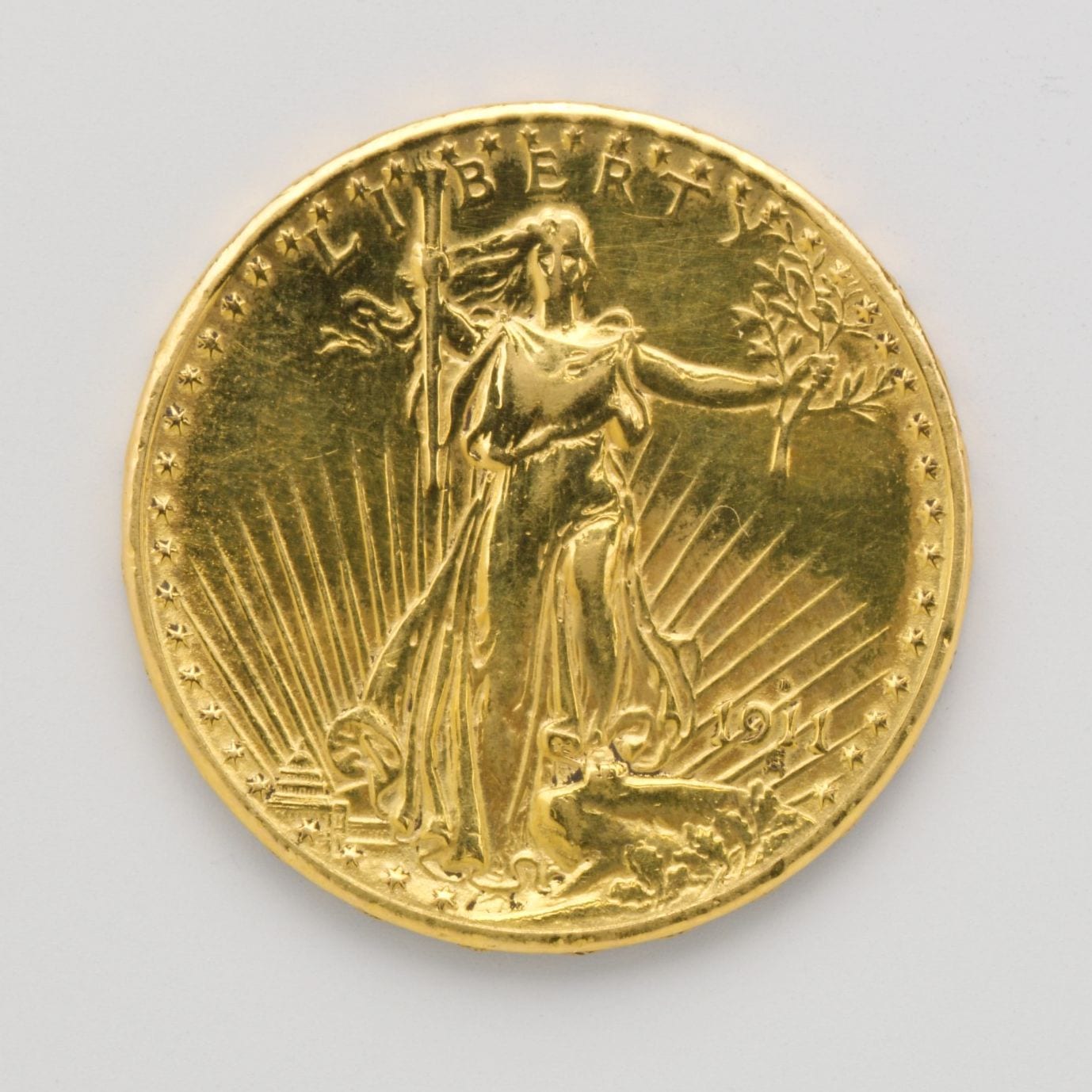
On 11 November 1905 Augustus Saint-Gaudens wrote to Theodore Roosevelt about a coin that did not yet exist. One face, he explained, would carry an eagle close to the bird he had already placed on the president’s inaugural medal. The other would show Liberty striding forward as if over a mountaintop, a torch in one hand and her drapery lifting in the wind. He ended with a sentence that still reads like a manifesto for the whole project: “My idea is to make it a living thing and typical of progress.” The letter is preserved and quoted by the National Park Service, which runs Saint-Gaudens National Historical Park.
What followed was one of the most closely watched collaborations between an American president and an artist, and one of the more bruising encounters between a sculptor and a government factory.
A sculptor at the Mint
Roosevelt commissioned Saint-Gaudens in 1904 to design three coins: the ten dollar gold piece, known as the eagle, the twenty dollar gold piece, or double eagle, and a one cent coin that was never produced. The park’s own account of the coin designs makes a point that is easy to forget. Saint-Gaudens was the first sculptor to design an American coin. Until then, the designs had come from engravers employed by the Mint itself.
The two men had already worked together. Saint-Gaudens designed Roosevelt’s 1905 inaugural medal, and both agreed that the coins of ancient Greece should be the starting point for the new gold. The new coins, they decided, would take that cue while carrying figures and symbols of the United States.
Saint-Gaudens did not take the job lightly. In a letter of June 1906 he told the president that the responsibility hung over him like a ghost. He was also unwell, and the work would be finished with the help of his studio.
From scrap paper to plaster
The material preserved at the park shows how a coin was built in a sculptor’s studio rather than an engraver’s workshop. Saint-Gaudens began with quick sketches on whatever paper was to hand, intended only to fix an idea. The real designing happened in clay, in circular reliefs about twelve to thirteen inches across. According to the park, roughly 75 sketch models survive for the ten and twenty dollar coins. Once a design was settled it was cast in plaster and sent to the Mint, where a reducing machine, the Janvier lathe, translated the large relief down to coin size.
Much of the hands-on modelling fell to Henry Hering, the studio assistant who executed both coins under Saint-Gaudens’s direction. Hering later wrote an account of the episode, now published by the National Park Service, and it is the closest thing to an inside view of what went wrong.
The eagle and the feathered headdress
The two coins took different paths. On the twenty dollar piece, Liberty holds a torch and an olive branch on the obverse, and an eagle flies across the reverse. On the ten dollar piece, Liberty appears as a head wearing a Native American feathered headdress, and the reverse shows a standing eagle close to the one on the 1905 inaugural medal.
The headdress was Roosevelt’s suggestion. He particularly liked the sketch of Liberty for the ten dollar coin, and in March 1907 he wrote to defend the choice on national grounds, arguing that the feathers could stand in for the traditional cap of Liberty and that “we are entitled to a typically American head-dress for the lady.” The phrase is revealing. Both men wanted the authority of the Greek coin, but Roosevelt in particular wanted the result to look unmistakably American.
Nine blows of the press
The trouble came at the Mint in Philadelphia. Hering describes the chief engraver, Charles Barber, rejecting the first, very high relief model as impossible to strike. Hering pressed on. A trial coin was placed in the hydraulic press and struck, then struck again, each blow bringing up a little more of the modelling, until on the ninth strike every detail appeared. The press was working at 172 tons.
That process could produce a handful of extraordinary pieces but never a coin for commerce. Hering also noted that repeated stampings forced gold out through the collar of the die, leaving a thin fin around the rim. He found the Mint’s machinery about forty years old and out of date, and he argued for a Janvier reducing machine, which Roosevelt eventually had installed at Philadelphia.
CoinWeek records that the first striking of the twenty dollar design, in March 1907, produced about two dozen proof pieces, each needing nine impressions. These ultra high relief patterns are counted at roughly two dozen in Wikipedia’s summary as well.
Hering made a second, lower model, and then a third that was lower still. Barber turned down both. Saint-Gaudens died in August 1907, before any version of his design had gone into circulation. In Hering’s account, the high relief coin was released around 18 November 1907, and a low relief version reached circulation late that year or in January 1908. Barber lowered the relief so that the coin could be fully struck with a single blow, the change that made the design workable for everyday use. Hering refused to approve the low relief coin that first went out, and the argument was settled in spring 1908 only after he produced three Janvier reductions of the ten dollar piece at different heights of relief for comparison.
The missing motto
The new gold carried another provocation. The coins of 1907 were issued without the words “In God We Trust.” Roosevelt objected to the motto on religious grounds. Congress disagreed, and legislation restored it in 1908. In 1908 alone, CoinWeek reports, the Philadelphia Mint struck 4,271,551 double eagles without a mintmark. The design remained in production until 1933.
What survives
Roosevelt never wavered in his view of the result. In a 1908 speech at the Corcoran Gallery he called the coins more beautiful than any struck since the time of the Greeks, crediting both Saint-Gaudens’s mastery of his craft and the daring of his imagination. Augusta Saint-Gaudens, the sculptor’s widow, wrote to thank him.
The best place to see the process rather than the product is the national historical park. Its New Gallery shows the gold coins alongside original twelve inch plaster models of early versions, including the design for the cent that was never struck. The models make the gap between studio and Mint visible. They are sculptures first, and the coins are their reductions.
The finished coins also sit in museum collections as works of art in their own right. The Metropolitan Museum of Art holds a twenty dollar gold piece in its American Wing, catalogued under Saint-Gaudens’s name with the design dated 1905 to 1907 and the coin itself struck in 1911, a gift of Heinz L. Stoppelmann in 1979. It measures about 3.3 centimetres across.
That cataloguing choice says something about how the double eagle is understood. A coin struck four years after the sculptor’s death, from a design flattened by another hand to suit the press, is still filed as his work. The relief was lowered by the Mint, and Congress added words he had left out. Yet the striding figure and the flying eagle remain recognisably the ideas Saint-Gaudens described to Roosevelt in 1905. The patterns struck nine times in early 1907 show what the design could be. The circulating coins show how much of it survived the trip through a government factory.
Sources
- Augustus Saint-Gaudens, Theodore Roosevelt, and the Coin, National Park Service
- Design History of 1907 Gold Coinage, National Park Service
- Coin Designs, Saint-Gaudens National Historical Park, National Park Service
- United States Twenty-dollar Gold Piece, collection record 1979.486.8, The Metropolitan Museum of Art
- 1908 No Motto Saint-Gaudens Double Eagle, CoinWeek
- Saint-Gaudens double eagle, Wikipedia