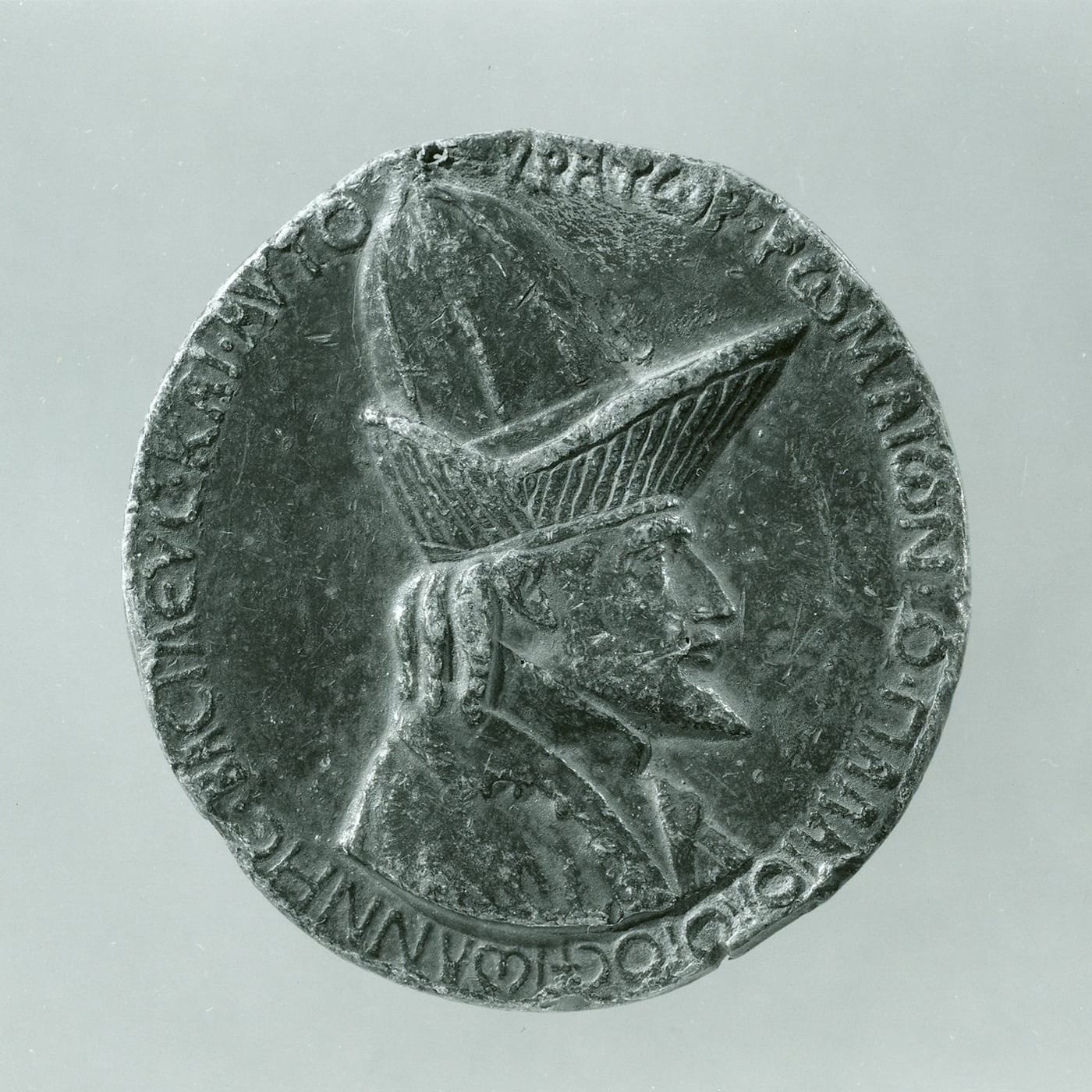
In 1438 the Byzantine emperor John VIII Palaeologus came to Italy to take part in talks between the eastern and western churches, a council that met first at Ferrara. Among the people who watched him there was the painter Antonio Pisano, known as Pisanello. The emperor’s visit is remembered in a cast bronze disc a little over ten centimetres across, and that object is generally taken to be the starting point of a new art form. The Victoria and Albert Museum describes its example as probably the earliest surviving Renaissance portrait medal.
A painter signs a medal
The obverse shows the emperor in profile, facing right, under a tall hat with a peaked brim. The hat is the most striking thing about the portrait. It rises high above the head and, in the description gathered by Wikipedia, takes up roughly half of the field, its jewelled crown pushing into the Greek inscription that names John as emperor of the Romans.
The reverse abandons the formality of the profile. The emperor rides to the right and stops to pray before a wayside cross, while a page on a second horse, seen foreshortened from behind, turns away into a rocky setting. On this side Pisanello signed the piece in Latin, OPVS PISANI PICTORIS, the work of Pisano the painter. The signature matters. The man who invented the portrait medal presented himself as a painter, and the reverse reads like a small painted narrative translated into relief.
The V&A example, cast in bronze and measuring 10.27 centimetres across, came to the museum in the Salting Bequest and is shown in its Medieval and Renaissance galleries.
Roman coins, Italian courts
The form had obvious ancestors. The V&A traces the two-sided portrait medal to Roman coins, with their ruler portraits on one face and allegorical images on the other. Those coins were turning up in the ground across Italy and were eagerly collected by humanist scholars.
The medal took the coin’s structure and changed its purpose. It was not money. It was cast rather than struck, usually in bronze, and it commemorated a person or an event. Medals worked as gifts and mementoes, objects to be handed over, kept and handled. Because they were cast from a model, they could be made in several examples, which allowed a likeness to travel well beyond the person who sat for it.
Architecture enters the reverse
Pisanello’s format was taken up quickly. Matteo de’ Pasti’s medal of Sigismondo Pandolfo Malatesta, lord of Rimini, is dated 1446 on its reverse, although the V&A places the actual making between 1449 and 1451. The obverse shows Sigismondo in profile to the left, wearing plate armour over mail, with a Latin legend naming him as the son of Pandolfo.
The reverse is the reason the medal is famous. It shows the castle of Rimini, inscribed as the Castle of Sigismondo at Rimini with the date 1446. According to the V&A, this is the first known depiction of architecture on a Renaissance portrait medal, and it reads as a frank statement of Sigismondo’s military power.
The medal also had a hidden life. Examples of Matteo’s Malatesta medals have been found buried as foundation deposits in buildings Sigismondo commissioned, including the fabric of the castle shown on this one. Here the medal acts less as a gift than as a signature placed inside the walls, a record meant for whoever might one day dig it up. The V&A’s example, cast in bronze and eight centimetres across, is displayed in its Medieval and Renaissance galleries.
Virtues in classical dress
By the later fifteenth century the medal had become a standard instrument of princely and papal image making. Niccolò Fiorentino’s medal of Pope Innocent VIII, dated 1486 in its legend, shows the pope in profile to the left wearing a cope. On the reverse stand three women in classical drapery who personify Justice, Peace and Plenty, identified by the inscription IVSTITIA PAX COPIA. Justice wears a winged headdress and holds a sword and scales. Peace is crowned with laurel and holds a cornucopia and an olive branch.
The pairing is typical of the developed form: a closely observed face on one side and, on the other, a programme of virtues that the sitter wished to be associated with. The V&A notes that the art form drew many specialist sculptors, because a ready market had grown among collectors from the educated classes and the gentry who were drawn to small works of art.
North of the Alps
The medal did not stay Italian. In Germany it took a different technical route. Hans Schwarz, born in Augsburg in 1492 and trained as a sculptor, made his first medals during the Imperial Diet held at Augsburg in the summer of 1518. He moved to Nuremberg in 1519 and was forced to leave the following year after disputes with the city’s authorities. He died at some point after 1521.
Schwarz carved his models in wood. A boxwood portrait of Katharina Starck, wife of the Nuremberg patrician Ulrich Starck, made around 1520, shows her in profile, with a chain at her neck and a hat whose decorated brim turns upward. It is only 5.1 centimetres across. A groove runs around its edge, which the V&A suggests was cut so that the moulds of obverse and reverse could be lined up for casting. No metal medal taken from this model is known. It survives as a portrait in its own right, and as a rare view of the stage before the bronze.
Leoni’s Michelangelo
A century and more after Pisanello, the portrait medal had become a currency of friendship among artists themselves. In 1560 Leone Leoni made a medal of Michelangelo, modelled in Rome and cast in Milan. The obverse shows Michelangelo’s bust to the right. The reverse shows a blind man, half naked, walking with a staff and a flask and led by a dog.
The V&A records that Leoni sent Michelangelo copies in silver and bronze, one of them specially cleaned and boxed, with a request to “keep it and look after it for love of me.” In return Michelangelo sent a wax model of Hercules and Antaeus, which does not survive. The medal circulated widely, carrying an error with it: the inscription gives Michelangelo’s age as 88, when he was in fact 85.
The object itself had shrunk along the way. The V&A’s Pisanello is 10.27 centimetres across, 0.8 centimetres deep and weighs 342 grams, a heavy thing to hold in one palm. Matteo de’ Pasti’s Malatesta, at eight centimetres, weighs 180 grams. Leoni’s Michelangelo measures 5.8 centimetres and is just two millimetres deep, with a recorded weight of about 20 grams. In our reading, the change in scale fits a change in use, from a princely commemorative piece to something closer to a personal keepsake.
The exchange shows how far the form had travelled. Pisanello’s medal of the emperor commemorated a state visit. Leoni’s medal of Michelangelo was a portrait made by one artist for another, sent as a token and answered with a gift of sculpture. Between the two lies the whole early history of the portrait medal: a small cast object with a face on one side and an idea on the other, made in numbers, carried in the hand, and kept.
Sources
- John Palaeologus VIII, medal by Pisanello, Victoria and Albert Museum
- Medal of Sigismondo Pandolfo Malatesta / Rimini Castle, by Matteo de' Pasti, Victoria and Albert Museum
- Innocent VIII, medal by Niccolò Fiorentino, Victoria and Albert Museum
- Michelangelo Buonarroti, medal by Leone Leoni, Victoria and Albert Museum
- Katharina Starck of Nuremberg, medal model by Hans Schwarz, Victoria and Albert Museum
- Medal of John VIII Palaeologus, Wikipedia